
Skip to content
calm and ready momsBook your slot

Let the path follow the child.

Most families choose a stream and a career the way they choose a school: by reputation, by what relatives did, by what feels safe. It is an understandable way to decide, and a thin one.

Aptitude gives the choice something steadier to stand on: what your child is naturally good at, read alongside what they enjoy and what their marks show. This guide explains what that means, what the research says, and what you can do at home, in plain language.

For mothers of children in Classes 8–12 · About a ten-minute read

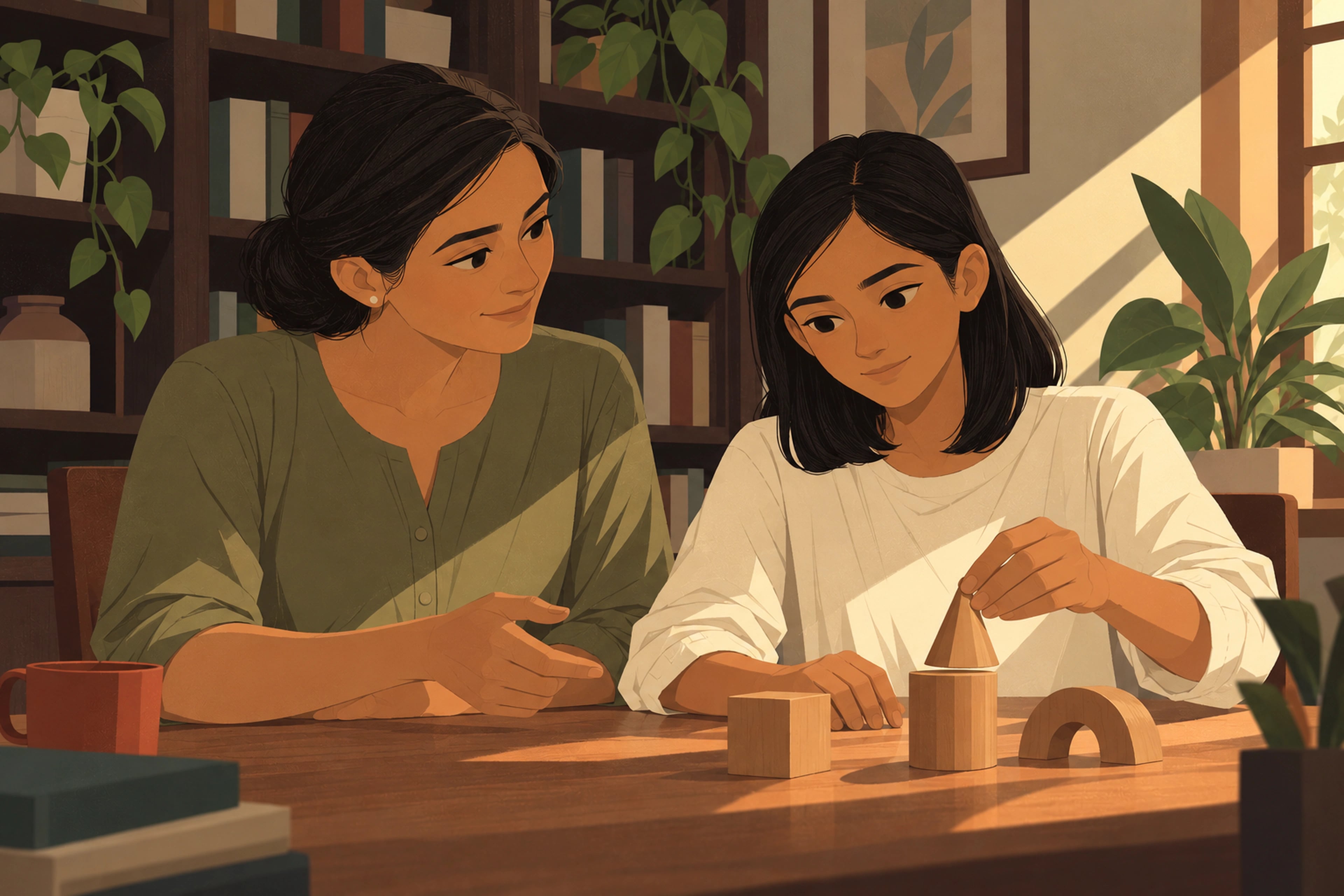
Illustration of a teenage girl building with wooden blocks while her mother watches beside her
Class 10 → 11 is the first big fork. The choice made at 15 shapes the options at 18. It deserves more than the result sheet.

Three things that are easy to mistake for one.

Marks are the number everyone sees, so they end up carrying the whole decision. Choose each one to see what it really tells you, and how to notice it.

What comes naturally.

The kinds of problems your child solves easily, and the ways they learn fastest: reasoning with numbers, with words, with shapes and space, or with their hands.

What you might notice
Some things click with almost no effort, even when they are not especially interested in them.
How it is measured
Properly, by a qualified professional using an established, validated assessment.

How aptitude shows up at home.

You do not need a test to start. Six questions to keep in mind over a few months. Patterns matter more than any single week.

Which homework is quick, and which drags?
Ease and speed on one kind of task, even one your child does not especially enjoy, often says more about aptitude than about effort.
What do they explain to other people?
Children tend to teach what they understand best: the rules of a game, how a gadget works, the plot of a story, how to fix something.
What do they do when nobody sets the task?
Free time shows interest. Building, drawing, organising, arguing a point, looking after someone younger: each points somewhere different.
Where do they lose track of time?
Absorption is worth noticing. When an activity holds your child without reminders, something in it fits the way they think.
Which marks are effortless, and which are hard-won?
The same result can mean very different things. Asking how a mark was earned tells you more than the mark does.
What do their teachers notice?
Teachers see your child among many others, across a whole year. Their view is a useful second lens on what comes naturally.

What the research says.

Four findings from peer-reviewed research and official figures, each named to its source. None of them says which path is right for your child. Together they say why the question deserves care.

Nearly half of teenagers expect to work in just ten jobs.

When the OECD asked 15-year-olds in its PISA 2018 survey what they expected to be doing at 30, 47% of boys and 53% of girls named one of just ten jobs, among them doctor, engineer, teacher, business manager and lawyer.

Those shares have grown since 2000, by eight points for boys and four for girls, even as the world of work has widened. The narrowing was strongest among children from less advantaged homes and among weaker performers.

What this means for you

A child who has heard of a handful of careers will choose from a handful. Seeing more of the map comes first, and it costs nothing but conversation.

OECD, Dream Jobs? (2020), from PISA 2018, average of the 41 countries in both the 2000 and 2018 surveys.

15-year-olds who expect one of ten jobs by age 30

Boys47%
Girls53%
Expect one of 10 jobs, 2018 Where it stood in 2000

Interests that fit the work predict success twice as strongly as interest alone.

A 2012 review pooled 60 studies, published between 1942 and 2011 and covering 15,301 people. People whose interests matched their work tended to perform better and stay longer, and students whose interests matched their course were more likely to stay with it and earn good grades.

The same researchers returned in 2017 with 92 studies. Interest scores on their own correlated .16 with performance. The fit between a person's interests and the work in front of them correlated .32, twice as strong. That fit is usually measured with psychologist John Holland's six kinds of interest, which you can explore on our home page.

What this means for you

“He likes computers” is a start. The useful question is what kind of work in that field suits the way he thinks.

Nye, Su, Rounds & Drasgow, Perspectives on Psychological Science (2012) and Journal of Vocational Behavior (2017).

How well each predicts performance, across 92 studies

Interest alone.16
Interest that fits the work.32
Correlation with performance at work and in study

The pattern of a child's strengths pointed to where they would thrive.

A US study followed 2,409 academically talented 13-year-olds for 25 years. How able they were predicted how much they went on to achieve. The tilt between their maths and verbal reasoning predicted where.

Children whose strengths leaned towards maths went on more often to science and engineering. Those whose strengths leaned towards words went on more often to the humanities and writing. These were exceptionally able children, so the study shows how much the pattern matters, not a rule for every child.

What this means for you

The shape of a child's strengths says as much as the total. Two children with the same marks can be suited to very different paths.

Park, Lubinski & Benbow, Psychological Science (2007).

A child whose strengths tilt to maths

Went on more often to science and engineering degrees, posts and patents

A child whose strengths tilt to words

Went on more often to humanities degrees, posts and published writing

An illustration of the finding. Bar lengths show the idea of a tilt, not study data.

About 5 seats for every 100 candidates.

About 23 lakh students sat NEET (UG) in 2024, and India had roughly 1.1 lakh MBBS seats. Each dot is a candidate, and the gold ones are the seats.

The same is true of many paths that a family hears about most often: the more popular the door, the more crowded it is. That is a reason to choose it for the right reasons, not a reason to avoid it.

What this means for you

Medicine is a wonderful path for a child suited to it, and a very competitive one. Knowing the other doors early means a capable child is never left with only one.

NEET (UG) 2024 candidates and MBBS seats, as reported by Careers360. Counts vary by source and date; MBBS only.

NEET (UG) 2024: candidates and MBBS seats

An MBBS seat A candidate
India's own education policy now calls for “no hard separations” between arts and sciences.

The National Education Policy 2020 asks for more flexibility and choice of subjects in secondary school, rather than one fixed stream at 15. As schools adopt it, the Class 10 to 11 decision becomes less a single door and more a set of combinations, which makes knowing your child's strengths more useful, not less.

National Education Policy 2020, Ministry of Education

When to start looking.

Earlier than most families do, and more gently. Each stage asks something different of you.

  1. Class 8–9

    Notice.

    Low stakes and plenty of time. Watch what comes easily and what keeps pulling your child back, and jot it down. Noticing is not deciding.

  2. Class 10

    Talk it through.

    Before the results, not after. Put strengths, interests and marks side by side, explore the options early, and consider an assessment by a qualified provider if it would help.

  3. Class 11–12

    Adjust, calmly.

    A stream is a starting point. With more subject choice arriving in schools, and more than one route into many careers, a thoughtful change of course is still possible.

  4. After school

    Build on it.

    Choosing a course, a college and a first direction draws on the same understanding. The work you did earlier keeps paying off.

Four things families often believe.

Each is understandable. Each, held too firmly, narrows the choice before your child has had a say.

  • Top marks pick the stream. A steadier view:

    Marks show what was taught and tested. Strengths and interests, read together, are a better guide.

  • A test will give the answer. A steadier view:

    A good assessment is one input. It needs a qualified person to explain it, alongside interest and context.

  • Some streams are a fallback. A steadier view:

    No path is a fallback. Different children are suited to different work, and every route has its own excellence.

  • Class 8 is too early. A steadier view:

    Noticing early gives you time, not pressure. Nothing has to be decided until it needs to be.

Questions about aptitude.

How is aptitude different from marks or interest?

Marks show what a child has been taught and tested on. Interest is what draws them in. Aptitude is what comes naturally. A fuller picture looks at all three, which is why marks alone are a thin basis for choosing a stream or a career.

When should we start thinking about aptitude?

Earlier than most families do. Noticing what comes easily and what keeps drawing your child back from Class 8 or 9 gives you time to look properly before the Class 10 to 11 choice, rather than deciding in a hurry after the results.

Do you run aptitude tests, and which one should we use?

We do not run tests and we do not name a provider. We explain why aptitude matters and what to look for in a qualified provider. Nothing on this site tests your child, and we collect nothing beyond your booking details.

What if my child's interests and strengths point different ways?

That is common, and useful to know. It often means looking for work that uses the strength in the setting of the interest. It is exactly the kind of thing worth talking through with someone, rather than settling by marks alone.

How does this connect to your services?

Career path selection is one of our four services for mothers of children in Classes 6 to 12. It starts with a free discovery call: you tell us what you have noticed, and we help you make sense of it and plan the next steps.

Bring what you have noticed to a free call.

Tell us what you have seen in your child. We will help you make sense of it, and plan the next steps with you. One to one, online, no obligation.